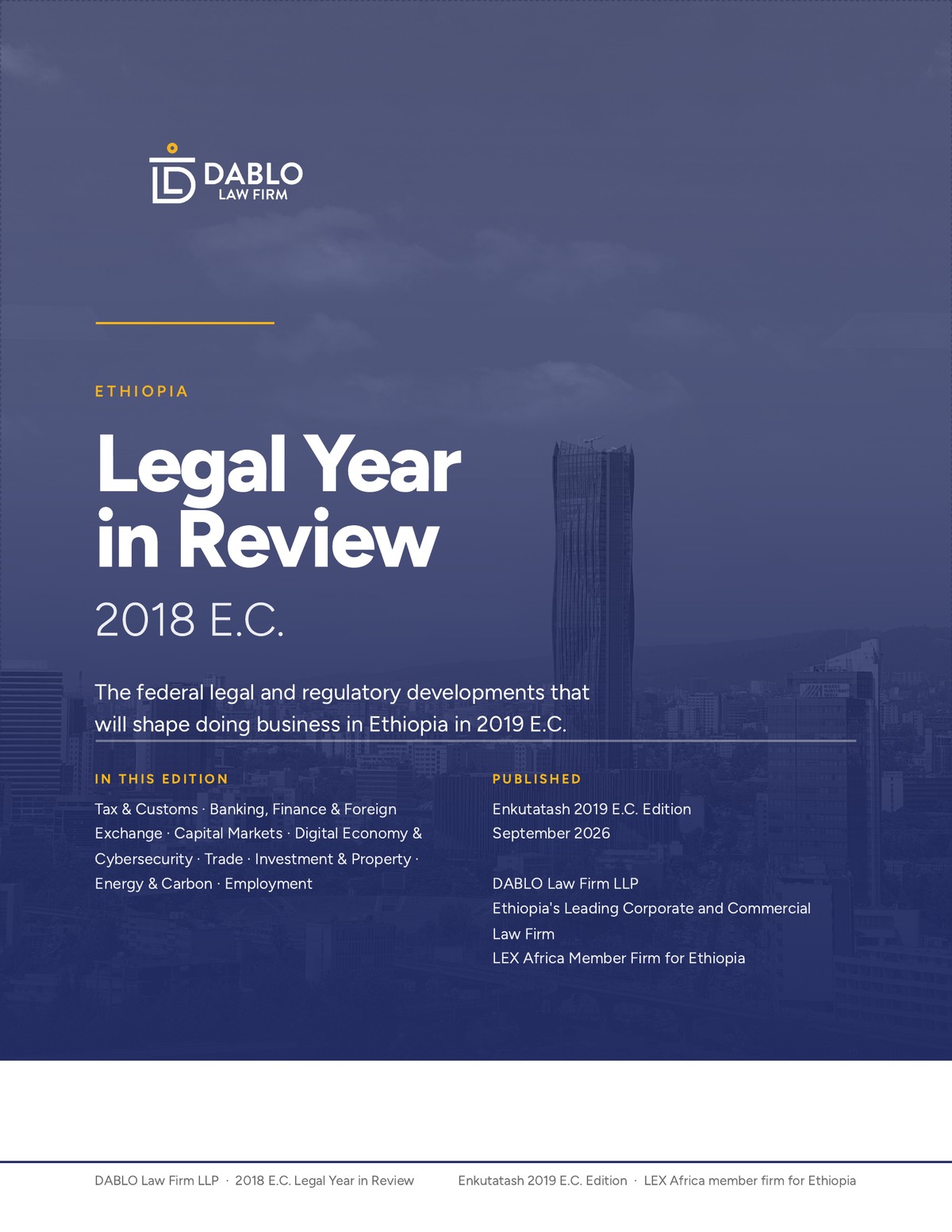
DABLO Law Firm LLP has published the Enkutatash 2019 E.C. edition of its annual Legal Year in Review — a practice-area survey of the federal legal and regulatory developments that will shape doing business in Ethiopia in the year ahead. This note sets out what changed in 2018 E.C., what the review contains, and how to obtain a copy.
The year the reform programme became a rulebook
For most of the past decade, Ethiopian regulatory reform has been discussed in the language of policy intention. In 2018 E.C. it acquired the language of dated compliance obligation. Federal output over the year ran well above the historical norm: the House of Peoples’ Representatives, the Council of Ministers and the federal regulators — the National Bank of Ethiopia, the Ministry of Revenues and the Ministry of Justice among them — issued instruments across investment, banking, taxation, trade, cybersecurity, energy and public administration.
DABLO has tracked that output through the year as part of our continuous federal regulatory monitoring practice. The review is deliberately selective. Rather than catalogue every instrument, it sets out the changes we consider most consequential for investors, financial institutions, importers and exporters, and employers operating in Ethiopia.
What changed in 2018 E.C.
The financial sector was rebuilt inside a nine-month window
The National Bank dismantled its administered interest-rate framework in favour of market pricing, moved banks onto a mixed Basel II and III capital regime with full compliance due on 31 December 2026, rebuilt reserve requirements around averaging and a single Payment and Settlement Account, capped foreign exchange exposure at ±18 per cent of Tier 1 capital, and repealed the mandatory Development Bank of Ethiopia bond holdings that had absorbed balance-sheet capacity. The foreign exchange amendments delegate profit and dividend remittance, external loans, letters of credit and cash against documents to commercial banks, subject to reporting. Each change carries a deadline against which supervisory action follows.
The capital market moved from framework to practice
The Ethiopian Securities Exchange admitted its first equity listings and the Ethiopian Capital Market Authority began registering securities in volume. The governing instruments predate the year; what changed is that they were applied. The positions taken in those first transactions on disclosure scope, legal opinion content and dematerialisation now function as market precedent for every issuer that follows.
Tax reform arrived as a single package
The Income Tax (Amendment) Proclamation carries the substantive charge — consolidated taxpayer categories, a gross-sales regime for smaller taxpayers, taxation of digital services and digital content, a minimum alternative tax, a charge on offshore indirect transfers, and pass-through treatment for limited liability partnerships. The Tax Administration (Amendment) Proclamation carries the assessment, filing, penalty and enforcement machinery. Neither is intelligible without the other, and the directive layer — electronic invoicing, VAT refunds, customs valuation and advance rulings on origin — is where both will be experienced in practice.
Investment incentives were recast around performance
Regulation No. 586/2018 replaces the 2022 incentive regulation and ties tax and customs benefits to performance criteria. The shift from status-based to performance-linked incentives changes what an investor is buying: the benefit is now contingent, which introduces a monitoring obligation and a clawback risk that must be modelled into project returns. Any incentive application structured under the previous regulation needs re-examination rather than renewal.
Residential property opened to foreign nationals
For the first time in Ethiopian law, foreign nationals may own residential housing, subject to a US$150,000 commitment per house, a public-bid lease requirement, a single-house limit and a prohibition on domestic financing. The implementing directive followed in August 2026 and governs what a prospective purchaser can actually do. No other instrument of the year has generated comparable client enquiry.
A compliance build-out whose weight falls in 2019 E.C.
Beneficial ownership disclosure, cybersecurity duties for designated critical infrastructure, electronic signature infrastructure and mandatory electronic invoicing all landed during the year, several with deferred commencement. The runway is the opportunity, and it is shorter than it appears.
What the review contains
The publication runs to ten sections, organised by practice area rather than by date.
- An executive summary setting out the year’s direction of travel, with the DABLO Perspective on what it means for regulated institutions.
- Priority actions — a table reducing the review to the steps we would put to an affected client at the start of a meeting, keyed to bank, taxpayer, investor, issuer and expatriate audiences.
- Key instruments at a glance — the fourteen instruments of widest application, with number, date and current status.
- Eight practice-area sections: Tax and Customs; Banking, Finance and Foreign Exchange; Capital Markets; Digital Economy, Cybersecurity and Data; Trade and Cross-Border Relations; Investment, Property and Infrastructure; Energy, Environment and Carbon; and Employment and Public Administration.
- DABLO Insight commentary on the instruments whose commercial consequence is not evident from the text — what the change does in operation, and what we would do about it.
- Measures awaiting Gazette confirmation, including the reported Federal Criminal Procedure and Evidence Code and the Carbon Market Proclamation, flagged for significance rather than certainty.
- An implementation watch for 2019 E.C., covering the Startup Proclamation and the draft Income Tax Regulation amendment.
How it was compiled
The review draws on DABLO’s internal 2018 E.C. federal legal instruments register — proclamations, Council of Ministers regulations and federal directives published or officially registered between 11 September 2025 and 5 September 2026 — cross-checked against the Ministry of Justice federal law repository and the National Bank of Ethiopia’s directives register. It covers federal instruments only. Where an entry carries a verification note, the instrument’s existence, number and date are established but the signed text was not available before the cut-off, and our commentary is confined to the framework in which it sits. We do not assert provisions we have not read.
Who should read it
The review is written for boards and general counsel of Ethiopian banks and insurers, prospective issuers and their advisers, inbound investors and their tax and treasury teams, importers and exporters, employers with expatriate staff, and foreign nationals considering residential acquisition. DABLO acted as Independent Legal Adviser on both first-wave bank registrations described in the capital markets section, covering legal due diligence, prospectus verification and the Independent Legal Opinion required under the Capital Market Proclamation and the governing ECMA directive — a combined registered par value exceeding ETB 69 billion.
Access the publication
The 2018 E.C. Legal Year in Review is available to read in full, together with the supplementary update covering instruments finalised after our research cut-off.
To discuss how any of the developments summarised here affect your operations in Ethiopia, contact us at
info@dablolawfirm.com or on
+251 938 888 887.
DABLO Law Firm LLP is a full-service corporate and commercial law firm based in Addis Ababa and the LEX Africa member firm for Ethiopia. This note is provided for general information, does not constitute legal advice, and no client relationship arises from reading it. © 2026 DABLO Law Firm LLP. All rights reserved.